
1127 results found for your search "Planning and Delivering D&T GCSE Compulsory Content"
Teaching electronics in KS3 D&T, This course has been created to help all D&T teachers improve their confidence and understanding of electronics within design and technology at secondary schools. Course objectives: A basic understanding of electronic concepts. Basic knowledge of key components. Design methods suitable for KS3 & 4. By participating in this course, you will: Learn how to develop an electronic solution to a problem. Find ways to move forward for curriculum and skill development. Upon successful...

Pneumatic systems - Make a Mascot, Pneumatic systems - Make a Mascot Years 3/4Age 7-9 yearsFirst published 2012 In this project children use pneumatics to design and make a mascot suitable for an opening celebration of an event such as a school-based version of the Olympics. They research a range of countries represented at the event and develop ideas that reflect the diversity of each country’s identity. The children explore the nature of pneumatic systems and how these can be incorporated into a design for a mascot, which they then make and...

Inspired by Industry Pentagram, Inspired by Industry: PentagramThis context invites students to explore how success can be recognised through the design of awards and trophies, inspired by Pentagram’s work on the UEFA Europa Conference League Trophy. Pupils follow a full design–make–evaluate process, from empathising with users to developing and prototyping ideas in CAD or with physical models. They can investigate form, symbolism, ergonomics, and materials, as well as rapid prototyping processes such as 3D printing or casting. Creative freedom is encouraged alongside technical skills in visual communication, modelling, and user-centred design, with opportunities to test concepts...

Aeronautical Engineering, These resources have been developed with the support of the ERA Foundation, to help students understand roles and career paths into design and manufacturing, with aeronautical engineering as the main context. They include eight video case studies of engineers with different roles, a teacher guide and a series of PowerPoint based challenges for Key Stage 3 students. In these the eight engineers are presented as drawn characters, offering challenges to: Understand the principles of flight by making a glider that flies the furthest Powered flight: adding power to make it...
Building Services Engineering, These resources have been developed with the support of CIBSE Patrons at the Chartered Institution of Building Services Engineers, to to help students understand roles and career paths into the industry. They include video case studies of five engineers with different roles, an introductory video, background information, and a series of PowerPoint based challenges for late Key Stage 2 and Key Stage 3 pupils in which they develop solutions in related areas. In these the five engineers are presented as cartoon characters, each offering a challenge to: • turn a playing field shelter into...

TetraGrow brings hydroponics into classrooms, Malaysian innovator Vengg Sathevil has combined creativity, technology, and sustainability to design TetraGrow, a hydroponic system aimed at making fresh vegetable cultivation accessible to everyone, even those without gardens. Inspired by a passion for plant growth, Sathevil’s project is not only a solution for urban dwellers but also offers rich educational opportunities for schools teaching design and technology. From concept to classroom-ready design TetraGrow applies hydroponic principles, growing plants without soil and instead nourishing roots through a nutrient-rich solution. Research highlighted that city residents often purchase pre-packaged vegetables...

Promoting Inclusivity in D&T at RNIB Webinar , The Royal National Institute of Blind People (RNIB) recently welcomed our Curriculum Consultant Lol Conway for an engaging and insightful webinar on inclusivity in D&T education. The session explored practical strategies to make D&T classrooms more accessible for students with visual impairments, ensuring all learners can fully engage with creative and technical learning. Lol, an experienced educator and advocate for inclusive D&T teaching, highlighted the importance of tactile learning, adapted tools, and sensory-friendly classroom environments. Key topics included health and safety adaptations, the use...

Consultants, Our D&T Independent Consultants offer a range of services on an independent, commercial basis. We also work alongside Local Authority Consultants employed by and confined to working within a Local Authority. Consultant members offer a range of services in support of design and technology practitioners and often work with the Association on a variety of D&T projects. Suitably qualified and experienced design and technology consultants can apply to become a Registered Design and Technology Health & Safety Consultant (RDTHSC), enabling them to provide training and accreditation to the D&T Association standards, working...
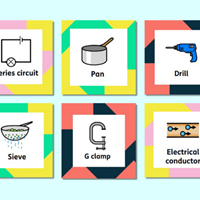
Teacher Toolkit Tuesday - Widgit symbols to support inclusive D&T teaching, Widgit, a leader in symbol-based communication tools, along with the D&T Association, have developed a comprehensive set of downloadable symbol resources designed to support students with special educational needs and disabilities (SEND). These visual tools help make learning in design and technology more accessible and meaningful, not only for pupils with SEND, but also for those with English as an Additional Language (EAL) or other learning barriers. Visual support that unlocks learning Symbols offer an effective way to reinforce understanding, particularly...

Flumps Poster, FLUMPS: A3 Poster An informative poster outlining how to analyse products and ideas in D&T. This follows 6 key areas of focus: Function, Looks, User, Materials, Pros/cons and Sustainability. It serves as a systematic approach to dissecting and evaluating various aspects of a design idea/project. By considering each element individually, students can gain a comprehensive understanding of the problem at hand and develop effective solutions and outcomes. This method allows students to be independent when analysing and ensures a wide range of areas are fully consideredUsing...
Choose an option to filter your search results.
All results (1127) Shop products (280) Events (63) News (274)