
From Classroom to Design Studio
D&T teacher Kim Yip spent four days inside the London studio of design consultancy PriestmanGoode as part of the Design & Technology Association’s ‘Teachers in Residence’ programme, gaining first-hand experience of how professional design teams approach briefs, develop ideas and design around real users. For Kim, one of the main reasons for taking part was the opportunity to see how a professional design consultancy operates and compare this with the design process taught in schools. Even the language used by designers provided ideas she could take back into the classroom. Rather than talking simply about a ‘design problem’, for example, the team discussed ‘pain points’ and ‘touchpoints’, terminology Kim felt could help students think differently about users and the challenges they are trying to solve.
Designing for People
A major part of the placement involved working on a future focused transport brief set in Manchester in 2035. Participants were given a series of scenarios and personas representing people with different needs, then asked to develop a response from the perspective of their chosen user. Kim and her fellow teachers focused on a musician who relied on public transport and struggled to move instruments and equipment around the city, particularly when travelling home after late night performances.
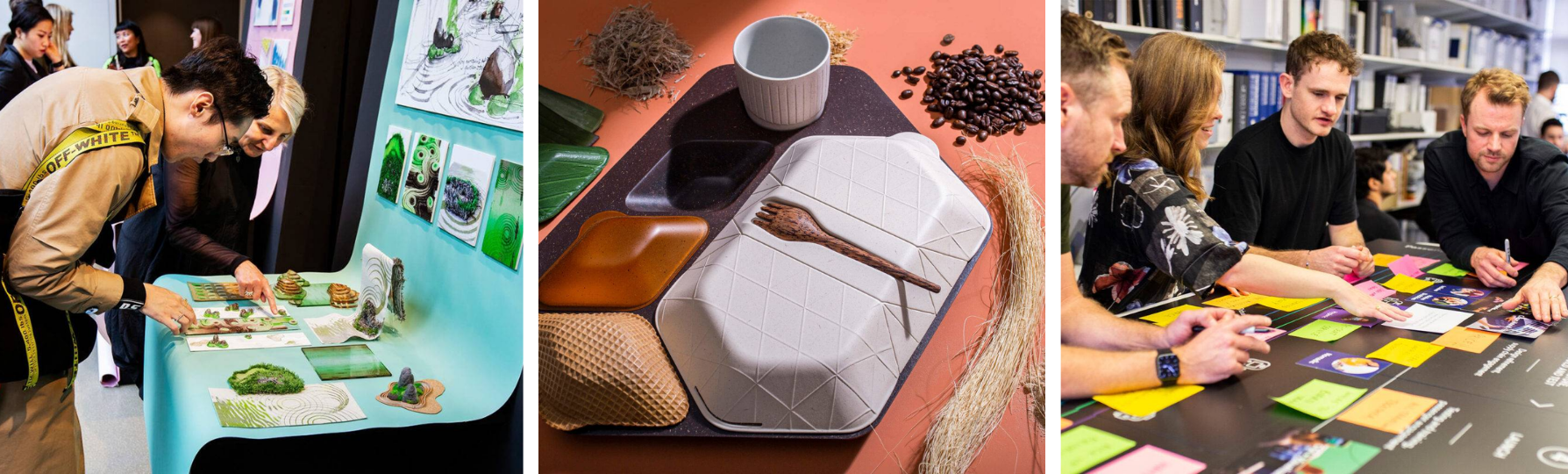
Their response was a transport pod that could move equipment independently between locations, allowing a musician to arrange for their instruments to arrive at a venue when needed rather than carrying everything themselves. The concept was developed through research, sketching, model making and visualisation before being presented to around 15 members of the PriestmanGoode team. The use of personas particularly resonated with Kim. In school, students are often encouraged to identify a client or user themselves. Giving them an established persona first could make this process more accessible, particularly for younger students, while encouraging them to consider needs beyond their own experiences.
Sketching to Visualisation
Throughout the placement, Kim met people working across different areas of PriestmanGoode, including strategy, branding, customer experience, visualisation and colour, material and finish, or CMF. This gave her a broader picture of the range of roles involved in taking a design from an initial idea through development. The visualisation team demonstrated how digital tools are used to create highly realistic representations of concepts. At the same time, the placement reinforced the continuing importance of traditional design skills.
Professional designers still sketch ideas by hand and use quick physical models made from materials such as foam board and wood to test proportions, construction and how different elements work together before progressing to a final outcome. For Kim, this provides a valuable real-world example to share when students question why they need to sketch, model and prototype rather than immediately make their finished design.
“It’s getting across that this is the process that you do. They all still draw by hand. As well as doing CAD work, they still draw and put ideas down.”
Kim Yip
Industry Practice in School
Another feature Kim hopes to recreate in her new school is PriestmanGoode’s materials library. The studio maintains a collection of materials that designers can see, handle and compare when developing projects. Kim saw potential for a similar resource within a D&T department, giving students the opportunity to physically explore materials and consider how different options might work together rather than encountering them only through worksheets or specifications.
The placement also encouraged Kim to think more deeply about accessibility and customer experience. Discussions with PriestmanGoode’s designers highlighted how seemingly small decisions can affect whether a product, service or environment works for someone with different physical, sensory or communication needs. Kim is now considering how the relationship with PriestmanGoode could continue beyond the placement, potentially through a workshop for students or a visit that would allow sixth form students to experience a professional design studio and respond to an industry led challenge. For Kim, the placement offered something difficult to replicate through conventional CPD: an immersive opportunity to work alongside designers, experience professional processes and see how the skills taught in D&T are applied within industry.
Email: amelia.wright@designtechnology.org.uk for more information about taking part in future Teachers in Residence placements.